Slovakia Presents Expo 2027 Pavilion Concept During Belgrade Visit
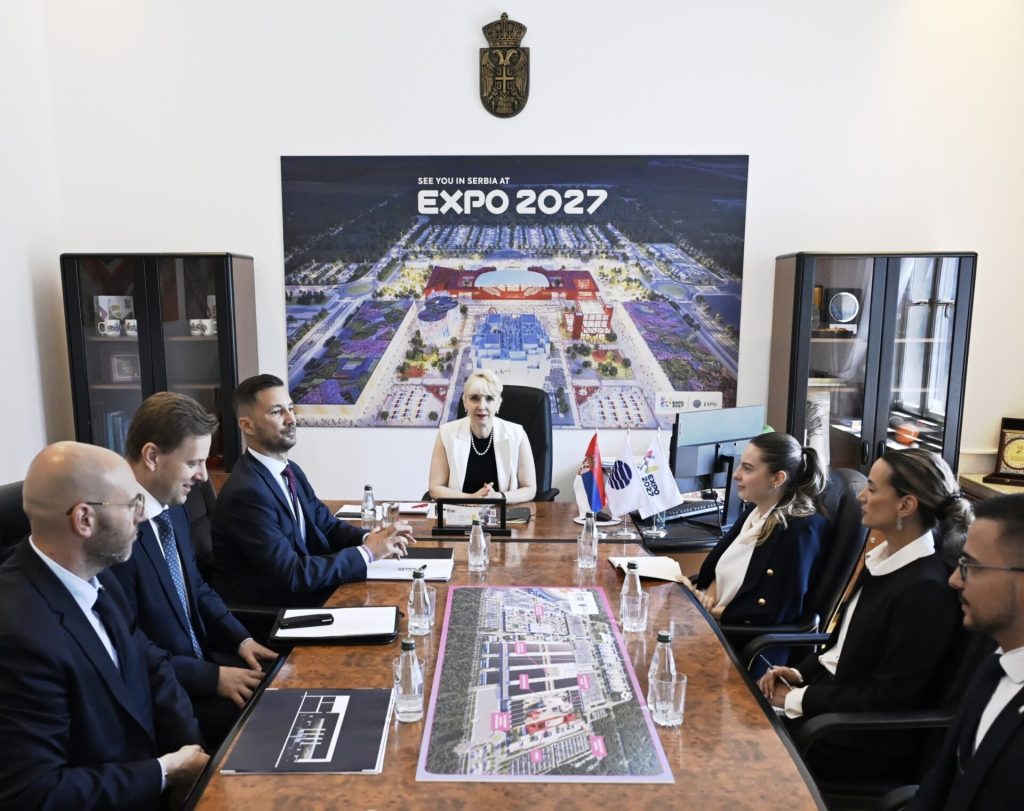
With less than a year to go until Expo 2027 Belgrade, Slovakia continues to serve as a pace setter among participating countries. The Slovak delegation travelled to the Serbian capital this month to present further details of its national pavilion concept during an official visit by Lukáš Parízek, Commissioner General of the Slovak Republic for Expo 2027 Belgrade, and Matej Fekete, Director General of Slovakia Travel.
The Slovak delegation met with Jagoda Lazarević, Serbia’s Minister of Domestic and Foreign Trade and Commissioner General for Expo 2027 Belgrade, at the Government of the Republic of Serbia on July 15. The meeting focused on the current status of Slovakia’s preparations, the development of the pavilion concept and the next implementation milestones ahead of the specialised exhibition, which will take place from May 15 to August 15, 2027.
Expo 2027 Belgrade will be held under the theme “Play for Humanity – Sport and Music for All” and is expected to bring together more than 140 participating countries. Slovakia was the first country to formally confirm its participation, a step Slovak officials have presented as evidence of the importance Bratislava attaches to the event and to relations with Serbia.
“We wanted to set an example and show how seriously we approach this project. It is a nice feeling to be first, but that is only the beginning. Our goal is to further deepen relations between Serbia and Slovakia and to take an active part in the preparations from this stage,” says Parízek.
Slovakia’s national presentation will be held under the theme “Slovakia – Playground of Opportunities,” which builds on the wider Expo theme. The concept is intended to present play not only as entertainment, but as a tool for creativity, innovation, cooperation and human connection.
During the Belgrade visit, the Slovak delegation presented visual and graphic renders of the planned pavilion, showing how the national theme will be translated into the visitor experience. The central symbol of the pavilion will be the “Tree of Opportunities,” an interactive installation through which visitors will be able to explore Slovakia across areas including culture, tourism, sport, gastronomy, business and innovation. Parízek said the pavilion was being designed as an experience rather than a traditional national display.
“We do not want people to simply look at our pavilion. We want them to experience it, explore it and, through their own choices, create their own experience. That is where we see the essence of inclusiveness and co-creation,” he said.
Slovakia’s presentation is expected to focus on four main pillars: next generation business, tourism, culture and sport. Sixteen different areas will be organised through these pillars, allowing visitors to engage with different aspects of Slovakia’s economy, society and national identity.
The business dimension has become an increasingly central part of Slovakia’s preparations. Slovakia Travel, the national authority responsible for Slovakia’s participation at Expo 2027, has signed a Memorandum of Cooperation with the Slovak Chamber of Commerce and Industry and Slovak Investment and Trade Development Agency to strengthen the business pillar of the national presentation. Tourism cooperation has also been reinforced through a separate memorandum between the Tourism Organization of Serbia and the Tourism Organization of Slovakia on the promotion of Expo 2027 Belgrade.
Parízek has said the exposition should be seen as a global business platform as well as a cultural and diplomatic event. In his view, culture, sport, tourism and innovation all have direct economic dimensions.
“When you present culture, you are also presenting the products, services and creative industries that accompany it. When you talk about sport, behind it stand companies, technologies and an entire sports industry. The same applies to tourism and innovation. Expo is a global business platform,” he said.
More than 140 countries are expected to be represented in Belgrade, creating what Slovak officials see as a rare opportunity for companies, public institutions and decision-makers to meet in one place. Parízek said the state can create the platform, but companies need to use it actively.
“The state can open doors, but companies must seize the opportunity themselves. Those who are ready to look for partners and develop cooperation will be able to gain enormous benefit,” he said.
The Slovak pavilion is expected to include a dedicated business area on its second floor. This space will be used for meetings between business representatives, experts and decision-makers from different sectors. Planned programming is expected to cover global challenges, public policy, innovation, culture and business, with content designed for both general visitors and specialist audiences.
During the July meeting, the Slovak and Serbian sides reviewed the main steps already completed in Slovakia’s preparation process. These include the formal signing of the participation agreement, the presentation of the national theme, participation in the Second International Participants Meeting in Belgrade, work on the pavilion concept and further coordination with Serbian and international partners.
The discussion also covered upcoming implementation milestones, including completion of the design submission process, obtaining the construction permit, pavilion handover and the start of construction works.
As part of the visit, Parízek also conducted interviews with several Serbian media outlets, In an appearance on the morning programme of state broadcaster Radio Television Serbia, he described Expo 2027 as an opportunity for countries to discuss shared challenges at a time of international tension and division.
Commissioner General Parízek, a former State Secretary at Slovakia’s Ministry of Foreign Affairs, has also emphasised the diplomatic value of the event. He said Expo creates a rare space for direct contact between countries at a time when global politics is increasingly shaped by sanctions, crises and geopolitical fragmentation.
“We live in a digital age and in the era of artificial intelligence, but nothing can replace direct contact between people. Social media is not enough. Expo is a place where the world meets to look for solutions together,” he said.
He also said Serbia’s position between different geopolitical and economic blocs should be seen as an advantage. While Slovakia strongly supports Serbia’s European path, Parízek said Serbia’s relations with a range of global partners and its free trade agreements make it attractive to international companies.
“The European Union is not the whole world. Serbia has a unique position, developed relations with different global partners and free trade agreements that are very attractive to international companies. Every situation creates new opportunities, and it is up to us to recognise them,” he said.
For Slovakia, Expo 2027 is therefore being framed not only as a tourism and culture showcase, but as a platform for economic diplomacy, business development and regional cooperation. Slovak officials have said the coming period will focus on the detailed pavilion programme, construction planning, business programming and continued coordination with Serbian and international partners before the event opens in May 2027.
Image credit Lukas Parizek, Slovakia Travel